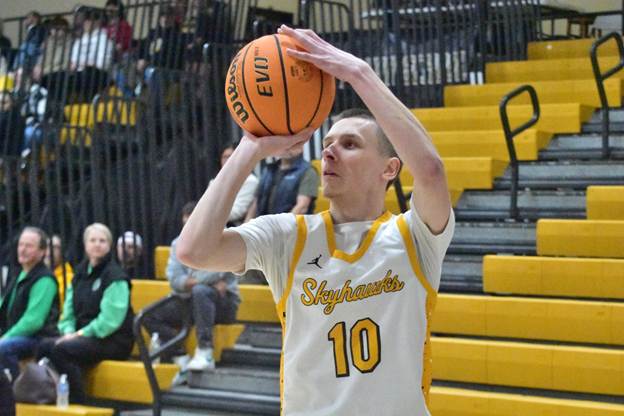
Basketball needs more players like NCAA Division III Waynesburg (Pa.) University freshman Tyler Walls, and not just because of his talent on the court.
He is everything you want in an athlete. The former Scott High School (W.Va.) standout turned-collegiate newcomer is a diligent worker who never settles for less than his best at any given time. A goal of his is to work harder than everyone.
When things are going well, he gives all thanks to the lord. When things are going bad, he still says it is God’s will and that God wants to teach you something, make you better and allow you to grow. He prays before every game, practice, and shootaround.
“When the coach says, ‘Oh, he’s the hardest worker,’ I want that to be me,” Walls said. “I want to be the best person I can be while on the court, and I want to bring others up. I want to be the loudest, the hardest worker, and the best I possibly can be.”
Even though he realizes it sounds cliché, basketball is his life. He wants to continue hooping after his college career and fulfill his lifelong dream by going overseas to play in a league in Lithuania, Spain, or Portugal.
Walls is not very talkative outside of basketball. He will talk to you if you try having a conversation with him, but he is a quiet guy.
However, he tries to be as nice as possible. Walls calls himself a nice, relaxed person to talk to.
Walls played 15 to 30 seconds of junior varsity basketball a game during his freshman year at Scott.
But he kept grinding and developed into a good player before eventually starting a few games his sophomore year. He played in the state tournament that season and started varsity in both his junior and senior years.
He said Skyhawk head coach Shawn Ballard gave him the keys to his success and helped him with his confidence. Walls said the latter was a major influence on him outside of God and his parents.
Walls averaged 13 points per game and made 80 three-pointers in his final season of 2024-2025 with Scott. He shot 38 percent from downtown and averaged two rebounds, two assists and two steals per contest.
He averaged 6.7 points a game with 1.3 rebounds and 1.5 assists per matchup in his junior campaign of 2023-2024 after averaging 4.1 points and 1.1 boards per game in his sophomore year.
“I think the lord has blessed me with great shooting ability, and if you can shoot, you can really play anywhere in basketball because every team needs a shooter on their team,” Walls said. “I think my defense has really improved since my beginnings in basketball. Freshman year in high school, I wasn’t good at defense. Now I feel like I’m the best at defense that I could be, I think. I think those two really help me succeed in basketball and put me in the position I am today.”
Walls believes being relaxed and confident in himself allows him to understand basketball and play with a sense of urgency, play with pace, and play how he wants to play rather than letting the defense dictate how his team would play.
Ballard said attention to detail and not just going through the motions were both crucial to Walls’ development over the years. The coach said Walls valued every rep in practice.
Ballard thinks Walls will have a really good collegiate career. With Walls’ work ethic, mindfulness and love for the game, Ballard believes he will continue to grow, develop, and end up being a really good college basketball player.
“Humble and driven would be two very good words to describe him,” Ballard said. “After great games, he’s still going to be hungry and come in to work the next day. No matter whether he had a good game or a bad game, his demeanor is going to be the same before, during, and afterward the next day at practice. That extends off the court too. He’s really focused on his goals, and he has a great work ethic. All-around, the kind of kid you want to be a part of your program.”
Walls also realizes he harbors major responsibility not only on the court but off it as well.
He spends a lot of hours studying as a college student. A typical day for him consists of six hours of basketball and three to four hours of class time with the rest being reserved for sleeping.
He is currently a sports media major at Waynesburg with a focus in sports announcing, and he is taking a sports writing course while also serving as the beat reporter for Waynesburg University women’s basketball.
“Now that we’re in season, we’re not doing a lot of heavy lifting,” Walls said. “We’ll do light workouts and keep your heavy weights for low sets and low reps about two to three times a week. Me, myself, I have to get 500 shots up a day in the preseason to make myself feel confident and to get my shot better and back where I want it to be before the season starts, so that will take about two hours of my day and then I’ll lift for about hour, hour 30 a day.”
Being in college has also made Walls realize that he must take his body seriously.
“Before college, my diet was really bad,” Walls said. “I was a junk food eater. I wasn’t caring about my diet, but now that I’m in college, I realize I have to take my body seriously in order to feel good and confident about my ability. It’s a lot of protein. I’m eating a lot of protein and getting about 150 to 165 grams of protein a day. I’m getting some carbs, and some fiber. It’s honestly meat, and the most vegetables I can possibly get are dining hall.”
Waynesburg head coach Tim Fusina thinks Walls can be a valuable player and make shots in the Presidents’ Athletic Conference.
Fusina recruited him in the spring. The Yellow Jacket coach said Walls does not see much action and that he had a concussion that knocked him out for about 10 days.
But they are trying to work Walls back in situations in practice where he can catch up, get better, and develop in practice.
“We’re all connected to each other every day,” Walls said of his Waynesburg teammates. “We have really good chemistry I think and we’re all friends. They’re really accepting of a freshman.”
In Fusina’s mind, Walls’s intelligence and respect will take him anywhere in life. The former is confident that the latter’s work ethic will eventually pay off for him.
“He’s a great listener,” Fusina said. “He does exactly what you ask. He does his best to do exactly what you ask. He’s a great student. Very conscientious. Very organized. He’s a great person. That has to do with the family that he has. I think they’re excellent people as well. He’s a real joy to coach and be around.”